
Layton Probate Court Records
Layton probate court records are filed and kept at the Second District Court in Farmington, which serves all of Davis County. When a Layton resident dies and their estate needs to go through court, the case opens at that Farmington courthouse. Records include petitions, wills, inventories, creditor notices, and final orders. You can search Layton probate cases through the Utah Courts XChange system online, or you can visit the court in person to look up files and get copies of documents you need.
Layton Quick Facts
Second District Court: Layton Probate Filings
All Layton estate cases go to the Second Judicial District Court. The courthouse is at 800 West State Street in Farmington, and mailing goes to PO Box 769, Farmington, UT 84025. You can reach the court by phone at (801) 447-3800. The clerk's office is open Monday through Friday. Layton is the largest city in Davis County, so a good share of the probate filings the Second District Court sees come from Layton residents and their families.
The Second District Court handles formal probate, informal probate, will contests, guardianships, and conservatorships. When someone in Layton dies with a will, the personal representative named in that will files the opening petition here. When there is no will, an interested party such as a surviving spouse or adult child files to be appointed administrator. Either way, the case file starts here and stays here through the close of the estate. All parties named in the case can see the public records in that file.
| Court | Second Judicial District Court |
|---|---|
| Address | 800 West State Street, PO Box 769, Farmington, UT 84025 |
| Phone | (801) 447-3800 |
| Hours | Monday through Friday, 8:00 AM to 5:00 PM |
| County Clerk/Auditor | 61 South Main Street, Room 101, Farmington, UT 84025 |
| Clerk Phone | (801) 451-3213 |
The Davis County Clerk/Auditor office at 61 South Main Street in Farmington handles many county records, including official filings and GRAMA requests. For probate court records specifically, the Second District Court clerk is your primary contact, but the Clerk/Auditor office can point you in the right direction for older or archived materials.
Search Layton Probate Records Online
The main tool for searching Layton probate court records online is Utah Courts XChange. XChange gives you access to case indexes for all Utah district courts, including the Second District in Farmington. You can search by the name of the person who died, the case number, or the name of the personal representative. The system shows case status, party names, and hearing dates. To view actual documents, you pay a per-document fee.
XChange fees are $5.00 to set up an account, $0.35 per search, and $1.00 per document. If you search often, a $40.00 monthly subscription is available. The system is available any time, and most active cases filed in the last several years will show up in searches.
Parties named in a probate case can use MyCourtCase at no cost to view their own case documents. For older Layton probate records not yet in the digital system, the Utah State Archives at 346 South Rio Grande Street in Salt Lake City holds historical court files. You can find more about what records exist and how to get them through the Davis County probate records resource.
In-person access at the Farmington courthouse is also straightforward. The clerk can pull case files for review during business hours. Plain copy fees are $0.25 per page and certified copies are $0.50 per page plus a $4.00 certification fee.
The Davis County court records page has guidance on what is available through the Second District Court and how to request copies of Layton probate filings.
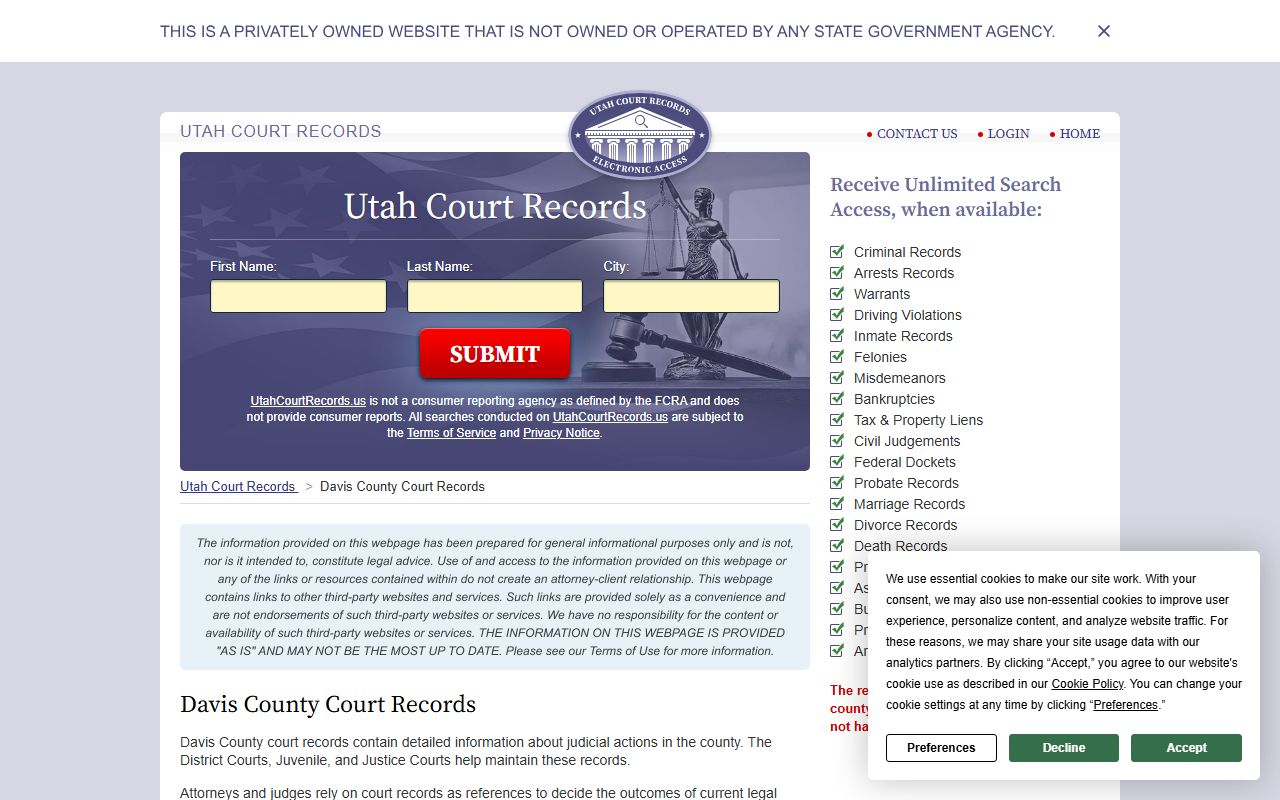
The Davis County probate records page at utahcourtrecords.us/davis outlines how to access Second District Court filings for Layton estate cases and explains copy fees and in-person procedures at the Farmington courthouse.
Layton Probate Records: What Is In the File
A Layton probate case file builds over the life of the estate. It starts with the petition to open probate and grows as the court receives more filings. Most files include the original will if one exists, the death certificate, an inventory of assets, notices sent to creditors, any creditor claims filed against the estate, and the orders the judge issues along the way. The final entry is usually the decree of distribution or a closing order.
Common documents found in Layton probate records include:
- Petition for appointment of personal representative
- Last will and testament and any codicils
- Inventory and appraisement of estate property
- Creditor notice and claims
- Court orders, rulings, and decrees
- Final accounting and distribution records
Guardianship and conservatorship cases are also handled at the Second District Court and are part of the probate division. These files cover situations where a Layton resident needs a court-appointed guardian due to incapacity. Those records may have restricted access for minor children.
Note: Some very old Davis County probate records may be on microfilm at the Utah State Archives rather than available in the digital court system.
Filing Layton Probate Cases
When a Layton resident dies, the estate must be filed with the Second District Court within three years. This deadline comes from Utah Code Title 75, which covers all probate matters in the state. Missing that window creates problems and can make it hard to settle the estate at all. The initial filing fee is $375. That covers opening the case and getting the process started at the Farmington courthouse.
Utah allows two paths into probate. Informal probate is simpler and faster. It works when there is a clear will and no disputes. Formal probate involves hearings before a judge and is used when there are conflicts or when no will exists. Either way, the personal representative must file an inventory within three months of being appointed and must notify known creditors. Creditors then have time to file claims before the estate can be distributed.
Layton estates under $100,000 may be eligible for the simplified affidavit process. This lets heirs collect assets without opening a full probate case. The heir signs a notarized affidavit affirming they are entitled to the property. Forms for this process are free at utcourts.gov/forms. Not every asset type is covered by this process, so it is worth checking before assuming it applies.
Utah's 120-hour survival rule applies to Layton estates. Under this rule, an heir must live at least 120 hours longer than the person who died in order to inherit. If that condition is not met, the heir is treated as if they died first. This rule is part of Utah Code Title 75 and affects how the court handles distribution when deaths happen close together.
Historical Layton and Davis County Probate Records
Davis County has some of the older court records in Utah. Probate records for the county go back to 1853 and court records to 1852. The FamilySearch Davis County genealogy guide covers what records are held and where originals are located. The Davis County Courthouse at 28 East State Street in Farmington holds some records, and older materials are at the Utah State Archives at 346 South Rio Grande Street in Salt Lake City, reachable at (801) 531-3848.
For Layton family history research, probate records can be valuable even when no estate dispute existed. They list heirs by name, describe property, and often note relationships between family members. Estate inventories can document what a household owned and where assets were located. These records are particularly useful for researchers tracing Layton families who lived in Davis County before the 20th century. The Utah State Archives can guide you on requesting specific historical files.
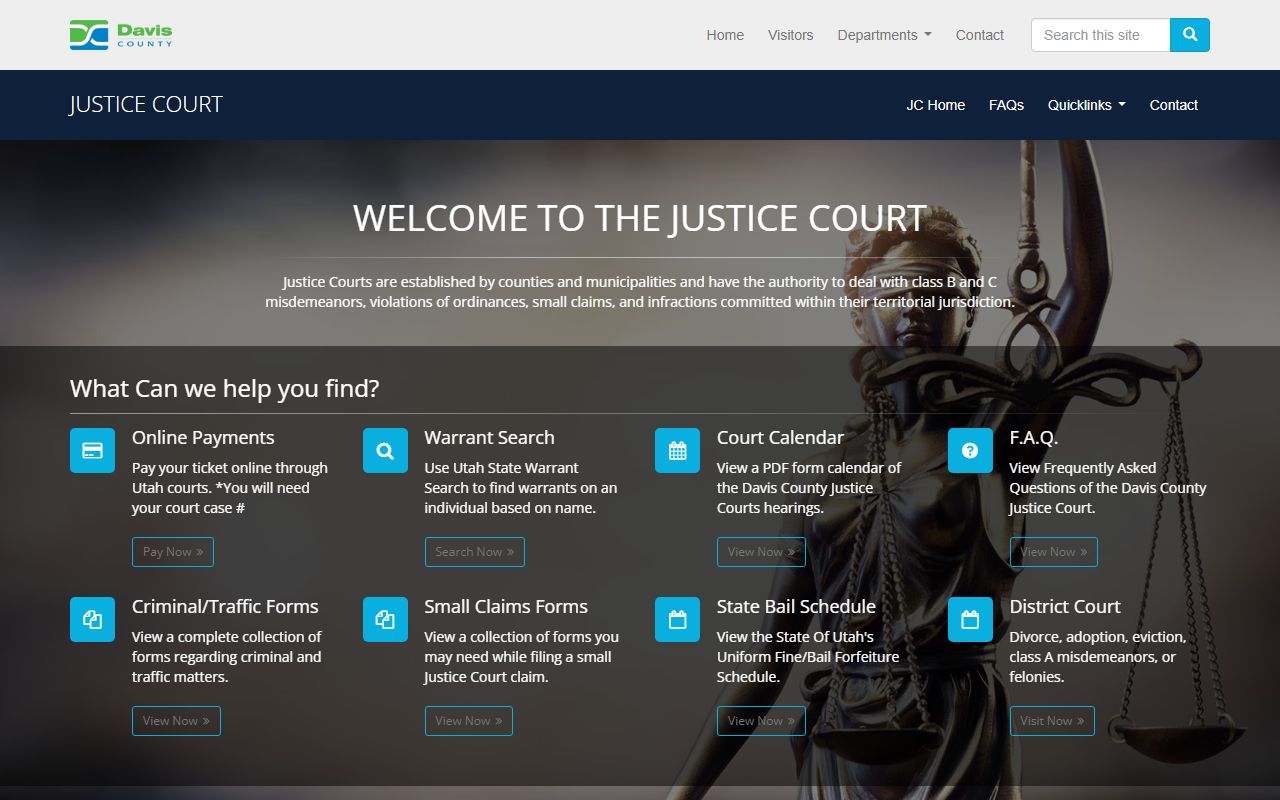
The Davis County Justice Court handles Class B and C misdemeanor matters for cities across Davis County including Layton, but probate matters belong to the Second District Court in Farmington, not the Justice Court.
Legal Help and Resources for Layton Estates
Not every Layton family needs a lawyer to get through probate. Small, simple estates often move through the process without legal help. But when there is a disputed will, complex assets, or disagreements among heirs, an attorney can save time and prevent mistakes. The Utah State Bar has a referral service where you can find probate attorneys who work in Davis County and serve Layton clients.
Utah Legal Services provides free or low-cost legal help to qualifying residents. If you are a Layton resident with limited income, you may be able to get help with a probate filing at no charge. The court self-help center in Farmington is another resource for people who want to handle probate themselves. Staff there can help you understand what forms to file and how to follow the right steps without giving legal advice.
Public access to Layton probate records is governed by the Utah Government Records Access and Management Act (GRAMA), found at Utah Code Title 63G, Chapter 2. Most probate filings are public records. A small number of guardianship files involving minors may have restricted access. If a record you want is not available through normal channels, you can file a formal GRAMA request with the court.
Nearby Davis County Cities
These cities are also in Davis County and use the same Second District Court in Farmington for probate filings.